
As lighting technology advances, choosing the right bulb goes beyond looks—it requires understanding specs, socket types, and local standards. E12 and E14 bases are common in decorative and compact lighting but aren’t interchangeable without adaptors.
This guide breaks down the differences between E12 and E14 LED bulbs, helping you make safe, accurate choices—especially in design-focused UAE interiors.
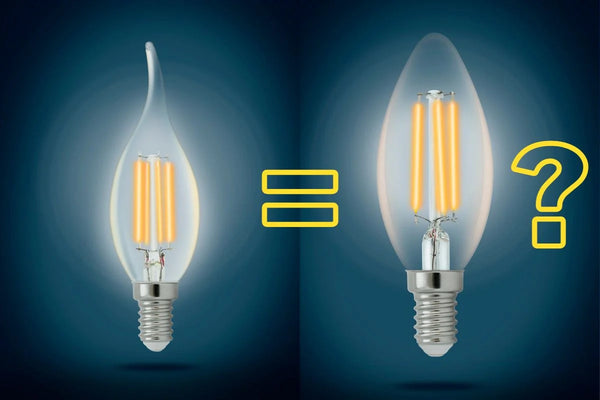
What Are E12 and E14 LED Bulbs?
Understanding Socket Nomenclature
Both E12 and E14 refer to Edison Screw (ES) bulb bases, a naming system inherited from Thomas Edison’s original bulb design. The "E" stands for "Edison," while the accompanying number denotes the base diameter in millimetres.
-
E12 LED Bulbs: Known as Candelabra Bases, these have a 12 mm screw diameter. They are common in smaller, ornate fixtures like chandeliers, wall sconces, and nightlights. E12 bulbs are especially prevalent in the United States and parts of Asia.
-
E14 LED Bulbs: Often referred to as Small Edison Screws (SES), E14 bulbs feature a slightly larger 14 mm screw base. These are widely used across Europe, the Middle East, Asia, and Oceania. In the UAE, E14 is the more commonly used format due to regional voltage standards and fixture designs.
While the bulbs share similar shapes and purposes, particularly for decorative or compact lighting, the 2 mm difference in screw diameter makes them fundamentally non-interchangeable without adapters.

Are E12 and E14 Bulbs Interchangeable?
Mechanical Incompatibility and Regional Relevance
Despite their comparable appearance and similar function, E12 and E14 bulbs are not directly interchangeable due to their differing diameters and regional usage conventions:

Though adapters exist to convert an E14 socket to accept an E12 bulb and vice versa, this workaround should only be used when electrical compatibility is confirmed, especially in high-voltage regions like the UAE.
What Do E12 and E14 Mean on a Bulb?
A Closer Look at Socket Standards
The numbers 12 and 14 in E12 and E14 respectively refer to the diameter of the screw base in millimetres. The Edison Screw standard allows for a variety of diameters, but E12 and E14 are among the most compact, making them popular for decorative and secondary lighting.
-
E12 Base (Candelabra Screw):
-
Diameter: 12 mm
-
Usage: Primarily in North America and select Asian countries
-
Applications: Chandelier arms, accent lighting, holiday decorations
-
-
E14 Base (Small Edison Screw):
-
Diameter: 14 mm
-
Usage: Predominantly in Europe, Asia, and the Middle East
-
Applications: Table lamps, sconces, smaller ceiling fixtures
-
In the context of UAE lighting design, E14 bulbs are often found in imported European fixtures, making them more readily available and supported by local infrastructure.

Can E12 Bulbs Fit E14 Sockets—or Vice Versa?
Use of Adaptors and the Importance of Fit
Technically, E12 and E14 bulbs cannot be used interchangeably without a size adapter. The 2 mm difference, though seemingly minor, is significant enough to prevent a secure mechanical or electrical fit. However, specially designed adapters can bridge the gap between these two base types.
-
E12 to E14 Adapter: Allows a smaller E12 bulb to be used in an E14 socket
-
E14 to E12 Adapter: Reduces a larger socket to accept an E12 bulb
When using adapters, it's critical to ensure the voltage compatibility of the bulb and fixture, especially in high-voltage systems (220–240V AC) prevalent in the Gulf region. A mismatch can result in flickering, poor connection, or potential electrical hazards.
E12 vs E14: Dimensional and Regional Differences

Breaking Down the Physical Specifications
In interiors across the UAE, especially in high-end residential and hospitality projects, E14 is generally favored due to its alignment with local voltage standards and compatibility with European-style fixtures.
How to Choose the Right E12 or E14 LED Bulb
Factors That Ensure Compatibility and Performance
Choosing the correct LED bulb base involves more than just matching the screw diameter. Consider these important parameters for optimal lighting selection:
-
Voltage Matching: Always ensure the bulb is rated for your local voltage supply (240V AC in the UAE). Installing a low-voltage bulb in a high-voltage system can cause damage or pose a fire risk.
-
Brightness (Lumens): Look for the lumen rating instead of just wattage. A higher lumen value means brighter light. Choose lumen output based on the function of the room—higher for task lighting, lower for ambiance.
-
Color Temperature (Kelvin):
-
2700K–3000K: Warm white, ideal for cozy settings
-
4000K–5000K: Cool white, better for task-oriented spaces
-
6000K and above: Daylight tones, suitable for commercial or clinical environments
-
-
Energy Efficiency: Opt for LED bulbs with high efficiency ratings. LEDs use significantly less power than incandescent bulbs and have a lower environmental impact.
-
Physical Size: Always confirm that the bulb’s overall dimensions (length and width) fit the intended fixture, especially in enclosed or decorative designs.
-
Dimmability: Not all LED bulbs support dimming. Check that the bulb is compatible with your dimmer switch model to avoid flickering or performance issues.
-
Quality Assurance: Select bulbs from manufacturers that offer clear certification standards, robust customer support, and warranty coverage. Longevity and performance vary widely between brands.

Final Thoughts: Making the Right Choice for Your Lighting Design
E12 and E14 LED bulbs serve similar purposes in the lighting ecosystem but are tailored to different regions, voltages, and fixture types. In the UAE, where 240V AC is the standard and lighting often blends European influences with Gulf aesthetics, E14 bulbs are typically the preferred choice. However, understanding the differences in base size, mechanical compatibility, and voltage requirements is crucial to making informed decisions for both safety and design integrity.
Whether you're illuminating a crystal chandelier in a majlis, accentuating a hallway with ornate sconces, or upgrading vintage fixtures in a modern villa, selecting the correct bulb base ensures both elegance and electrical compliance. With a well-informed approach, you can achieve refined lighting effects while maintaining reliability and efficiency across all interior spaces.